
From Mass Media to Tribe: Why Founders Own Distribution Now
The reason you are reading this is simple: you’ve seen founders launch, scale and dominate their categories with their personal brands. In some cases, one could argue the founder’s brand eclipses the company’s- would you consider Elon Musk is a bigger brand than Tesla, X or SpaceX?
Even closer home, Deepinder Goyal at Zomato (now Eternal), Kunal Shah have all built personal brands that go far beyond what their corporate brands help them achieve for their companies’ revenue, profitability and even funding.
It is one thing to look at these stars, and consider your own founder branding journey, which is just beginning. We need to remember, they started somewhere. And because they kept sharing their journey on an ongoing basis, they have kept the torch of their personal brand alive.
And there’s always a flywheel at work- an innovative founder launches a breakthrough product or service, and then has the potential to engage the world at large through their personal online presence.
Let’s understand what’s at play here.
For a century, reach was something you rented. You paid a newspaper, a network, or later an ad platform, and they lent you their audience for a moment. The moment ended when the budget did. That model built enormous companies, and it is quietly dying for founders who want to be known.
The reason is simple. Trust has moved from institutions to individuals. People no longer believe the brand's press release. They believe the founder who explains, in plain language, what the company is actually trying to do and why. When the messenger becomes the message, renting a stranger's audience stops making sense. You want your own.
This is the shift that runs under everything we do: from mass-media distribution to direct, one-to-many distribution and tribe building. It sounds abstract until you see what it changes in practice.
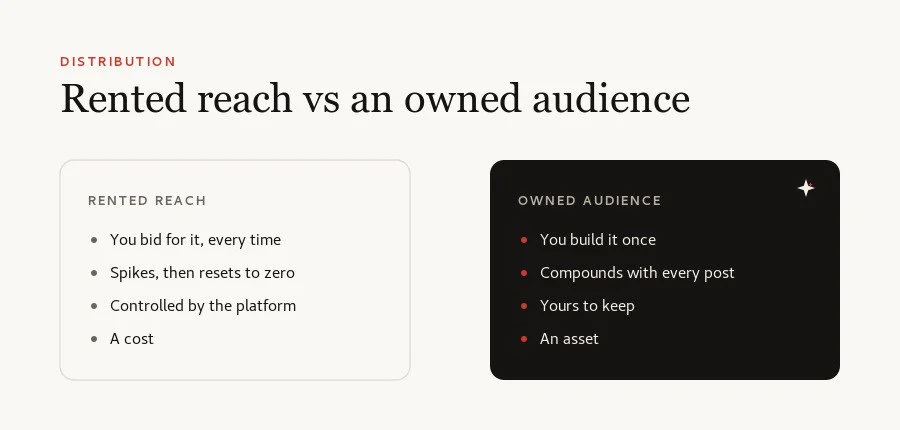
Rented reach versus an owned audience
Rented reach is expensive, temporary, and controlled by someone else. You bid for it, you get a spike, and then you are back to zero, bidding again. An owned audience behaves like an asset. You build it once and it compounds. Every post adds to a base that does not reset when you stop paying.
Consider the contrast. A traditional campaign disappears the day the flight ends. A founder who has published consistently for two years walks into every room pre-sold, because the people in it have already met their thinking. One is a cost. The other is equity.
The platforms did not create this shift, but they made it available to anyone. A founder in Gurugram can now reach the exact fund partners, operators, and customers they care about without a media budget or a PR firm's rolodex. What used to require gatekeepers now requires a point of view and the discipline to share it.
Tribe is not audience
Here is where most people stop short. They hear owned audience and think followers. Followers are a number. A tribe is different. A tribe shows up, argues back, forwards your posts to their boss, and tells you when you are wrong. It is small on purpose and loyal by design.
Kevin Kelly's old idea of a thousand true fans applies almost perfectly to founders. You do not need a million passive viewers. You need a few hundred people who genuinely care what you think, because those are the people who hire you, invest in you, join you, and refer you. Paul Graham built an entire fund's inbound on essays read by a self-selecting tribe of exactly the founders he wanted. He never bought an ad.
The distinction matters because it changes what you optimise for. Chasing audience pushes you toward reach and broad, safe content. Building a tribe pushes you toward depth, a real position, and the willingness to be uninteresting to most people so you can be essential to a few.
What this means for founders or CXOs building their own brand
Stop thinking about your presence as marketing you switch on for a launch. Start thinking about it as a standing asset you build in public, one post at a time. The distribution you own does not care about your quarterly plan. It is there when you raise, when you hire, when a crisis hits, and when a customer is quietly deciding whether to trust you.
It also changes how you spend. Money that once went to renting attention for a campaign is better spent building the muscle and the asset that keep paying out after the campaign is forgotten. The founders who understand this early are compounding a lead their competitors cannot buy back later.
If you want the practical version of how to build it, the ninety-day system lays out the exact cadence. Start there.
And if you want operators who have built brands and audiences at scale to build yours with you, that is what we do.