
The Quarterly Founder Branding Plan: A 90-Day System for LinkedIn and X
Most founders treat personal branding the way they treat the gym in January. A burst of posts, a week of replies, then silence for two months while the business takes over. The problem is not discipline. The problem is that they are running an infinite game with no plan, no scoreboard, and no finish line in sight.
A quarter fixes that. Ninety days is long enough for compounding to show up in your inbox and short enough that you can hold yourself to it. This is the exact quarterly plan I build for founders and CXOs, laid out in full. You can run it yourself. Nothing here requires a budget, a team, or more than four to five focused hours a week.
Why founder branding is worth a quarter of your attention
Start with what buyers and investors actually do before they meet you.
The 2024 Edelman-LinkedIn B2B Thought Leadership Impact Report found that 73% of decision-makers say an organisation’s thought leadership is a more trustworthy basis for assessing its capabilities than its marketing materials. Three quarters said strong thought leadership prompted them to research products or services they had not previously considered. And roughly nine in ten said they are more receptive to outreach from companies that consistently publish quality thinking.
Read that again from the other side of the table. Your next client, investor, or senior hire is forming a view of you from your public writing before you ever get a meeting. If there is nothing to read, they form their view from silence.
The 2026 Edelman Trust Barometer adds a second layer: trust worldwide is retreating into smaller, familiar circles, and generic corporate communication is losing credibility fastest. People trust identifiable humans with a track record of showing their thinking. That is precisely what a founder brand is.
For founders in this region, the ground is unusually favourable. India is LinkedIn’s second-largest market, with membership estimated at over 140 million, and the Gulf’s professional class lives on the platform. Yet the share of founders here who publish consistently is tiny compared to the US. The arbitrage is real and it will not last five years.
The two platforms play different positions
Before the plan, get the division of labour right, because most founders get it backwards.
LinkedIn is where decisions get made. Your buyers, board members, journalists, and future employees are all there under their real names and job titles. LinkedIn rewards depth, consistency, and comment-driven conversation. This is your primary platform and where roughly 80% of your effort goes.
X is where reputations travel. It is faster, more global, and more connected to the tech, VC, and media conversation. A sharp take on X can reach a US investor or an international journalist in a way a LinkedIn post rarely does. But it is a momentum platform, unforgiving of occasional posting. Treat X as your syndication and listening channel first, and only make it a primary channel once LinkedIn is running smoothly.
The practical rule: create for LinkedIn, adapt for X. Never the reverse.
The 90-day Founder branding plan
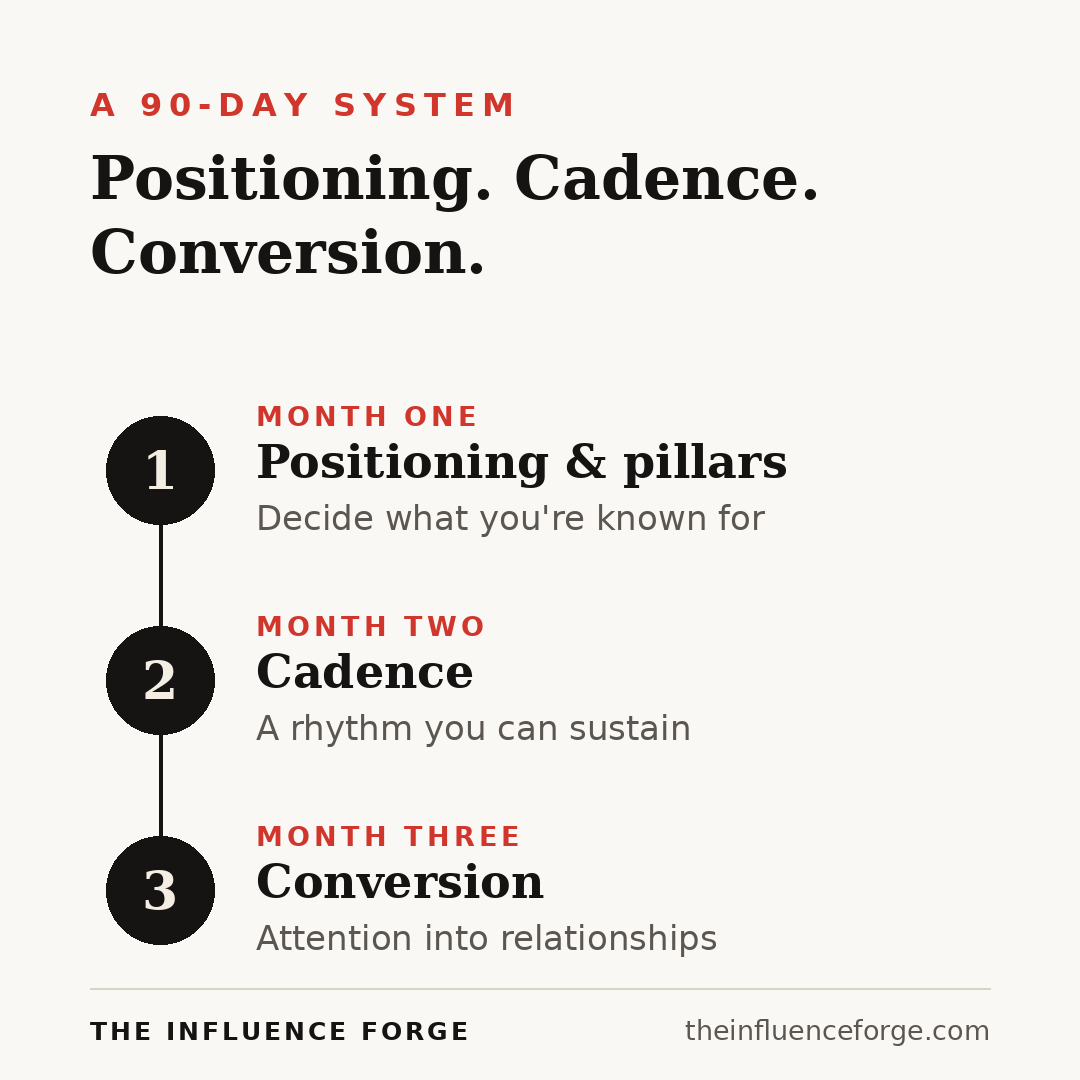
The quarter breaks into three phases: build the machine, run the machine, then point the machine at bigger targets.
Month 1: Positioning and foundation (weeks 1 to 4)
Everything downstream fails if this month is skipped, and it is the month everyone wants to skip.
Week 1: Write your positioning sentence. One line: “I am the [role] who [specific point of view] for [specific audience].” Not “passionate about building brands.” Something like: “I run a 40-restaurant chain and I write about what actually breaks when Indian F&B businesses scale.” The test of a good positioning sentence is that a stranger could predict your next ten posts from it.
Week 2: Choose three content pillars. Three, not five. A useful mix is one industry pillar (the inside view of your market that outsiders cannot see), one operator pillar (decisions, mistakes, and numbers from running your company), and one personal-lens pillar (how you think, what you read, what changed your mind). Every post for the next 90 days lives inside one of these.
Week 3: Rebuild your profiles. LinkedIn headline rewritten around your positioning sentence, not your job title. About section written in first person, opening with the problem you understand better than almost anyone. A banner that states what you do in plain words. On X, a bio that matches, so someone arriving from either platform meets the same person.
Week 4: Build a 25-idea bank and publish your first two posts. Go through your last 90 days of work: client conversations, pricing decisions, hiring calls, things that surprised you. Each one is a post. Write the list before you need it, because the single biggest cause of founder-brand death is staring at a blank compose box on a busy Tuesday.
Month 1 output: positioning sentence, three pillars, rebuilt profiles, 25 banked ideas, 2 posts published.
Month 2: Cadence and rhythm (weeks 5 to 8)
Now you run the machine. The target cadence:
LinkedIn: 3 posts per week. One industry insight, one operator story, one shorter observation.
X: 4 to 5 posts per week. Adapted LinkedIn ideas, quick takes, replies to larger accounts.
Both platforms: 20 minutes daily of substantive comments on 5 to 8 posts by people your audience follows.
Three notes on making this sustainable rather than heroic.
Batch the writing. One 90-minute session a week produces all three LinkedIn posts. Founders who write daily burn out; founders who batch weekly still have a brand in December.
Comments are half the strategy. A thoughtful comment on a post by a well-followed operator or investor puts your name in front of their audience at zero cost. Edelman’s research shows decision-makers spend an hour or more a week reading this kind of content. They see the comments too.
Write like you talk in a board meeting, not like a brand. First person. Specific numbers where you can share them. One idea per post. The posts that build founder reputations are almost never clever; they are unusually honest about ordinary decisions.
Month 2 output: 12 LinkedIn posts, 18 to 20 X posts, a daily engagement habit, and your first inbound signals, which usually appear as DMs and profile views from exactly the people you named in your positioning sentence.
Month 3: Leverage and proof (weeks 9 to 13)
The machine runs. Now raise the ceiling.
Publish one flagship piece. A long-form post or article that only you could write: a teardown of a decision you got wrong, the real unit economics of your category, a contrarian read on news everyone in your industry is discussing. Cite reputable sources, name real numbers, take a position. This is the piece that gets forwarded, and forwarded pieces are how founder brands jump networks.
Convert attention into relationships. Every week, move two or three conversations off the feed: a DM to someone who comments regularly, a coffee with a fellow operator, a reply to a journalist covering your space. The feed creates familiarity; the relationships create outcomes.
Review the quarter with real numbers. Not follower count. Track four things: profile views per week (are the right people looking), inbound DMs and meeting requests (is attention converting), comments from your named target audience (is the positioning landing), and one business outcome you can trace to the content, whether that is a candidate, a client conversation, or a press mention. If three of the four moved, the system works. Adjust pillars, not effort, and roll into the next quarter.
Month 3 output: one flagship piece, 10 to 12 new real relationships, a quarterly review, and next quarter’s plan drafted in an hour instead of a month.
Notes for founders in India and the Gulf
The plan above works anywhere. Three adjustments make it work better here.
Write for the room you actually operate in. US founder-brand advice assumes a market saturated with operators posting daily. In Mumbai, Bengaluru, Dubai, or Riyadh, the bar is lower and the rooms are smaller. The buyer, the banker, and the journalist covering your sector often sit two connections away from you on LinkedIn. Specificity about your city and your category outperforms global hot takes every time. A post about mall rentals in Gurugram or Saudisation hiring in Riyadh will do more for your pipeline than a post about what Jensen Huang said this week.
Respect the calendar. Business attention in the Gulf reorganises around Ramadan, and in India around Diwali and the March fiscal year end. Do not fight these rhythms; plan them. A quarter that includes Ramadan should front-load flagship content before it begins and shift to lighter, more reflective posts during it. This is also why the quarterly planning unit beats an annual content plan: you re-plan around the calendar four times a year instead of pretending January-you could see December.
Relationships close faster here, so Month 3 matters more. In markets where business still runs on personal trust and referral, the off-feed conversion step is not an optimisation, it is the whole point. A founder in the Gulf who converts ten feed relationships into ten majlis-style coffees per quarter will outperform one with triple the impressions who never leaves the platform.
Where Founder Branding Fails:
Having run this system with founders across F&B, SaaS, and services, the same four failures account for nearly every stalled founder brand.
Posting about the company instead of from the founder. Product updates belong on the company page. Readers follow you for judgement, not announcements. Your company should appear in your content as supporting evidence, never as the headline.
Chasing virality. One post that reaches 500 of the right people in Gurugram, Dubai, or Riyadh is worth more than one that reaches 50,000 of the wrong ones. Write for the 500.
Quitting in week 6. The dead zone between weeks 4 and 8, when effort is real and results are quiet, is where most founders stop. The compounding is back-loaded. Decision-makers researching you consume many pieces of your content before you ever hear from them, which means the silence is not absence of results. It is results you cannot see yet.
Delegating the thinking. You can get help with editing, research, and consistency. You cannot outsource your point of view. The founders whose brands actually move markets are recognisably themselves in every post.
What one quarter realistically buys you
Not fame. After 90 days of this plan you should expect roughly 35 to 40 LinkedIn posts and 50-plus X posts published, a clear public position people can repeat back to you, warm inbound from a handful of exactly-right people, and a repeatable weekly system that costs four to five hours. Quarter two is where the flywheel becomes visible: speaking invitations, journalist queries, candidates citing your posts in interviews.
The founders who win this game are not the loudest. They are the ones still publishing in quarter four, saying something specific, when everyone who started with them has gone quiet.
Want the plan as a working document? I have turned this entire system into a free 90-Day Founder Branding Planner: the weekly checklist, the positioning worksheet, the idea-bank prompts, and the quarterly scorecard in one printable file.
Prefer to run it with a partner? I work hands-on with a small number of founders and CXOs each quarter on exactly this system, from positioning through ghostwritten execution. Get in touch and we will look at your quarter together.
Sources: 2024 and 2025 Edelman-LinkedIn B2B Thought Leadership Impact Reports, 2026 Edelman Trust Barometer, Business of Apps LinkedIn statistics.