
Executive Presence Before an IPO: The 24-Month Runway
Founders preparing to list spend eighteen months on the numbers and almost no time on the one asset the roadshow cannot manufacture: the market's opinion of the person at the top. By the time the bankers are in the room, that opinion is already formed. You are either a founder investors have heard think clearly for two years, or a stranger asking them to trust a deck.
Reputation compounds slowly, which is exactly why it has to start early. The analysts, anchor investors, and future employees who will decide how your listing lands form their view of you long before the prospectus. Executive presence before an IPO is not vanity. It is risk reduction.
Why 24 months, not two
You cannot cram a reputation. A founder who suddenly appears with polished thought leadership six weeks before a roadshow reads as exactly what it is, a campaign, and trust does not respond to campaigns. It responds to consistency over time.
Twenty-four months is the runway where compounding does its work. It is long enough to establish a track record of public thinking, to be quoted, to build relationships with the journalists and analysts who cover your sector, and to let your point of view settle into the market's memory. Start there and you enter the IPO window as an established voice rather than a scramble.
What to build, and when
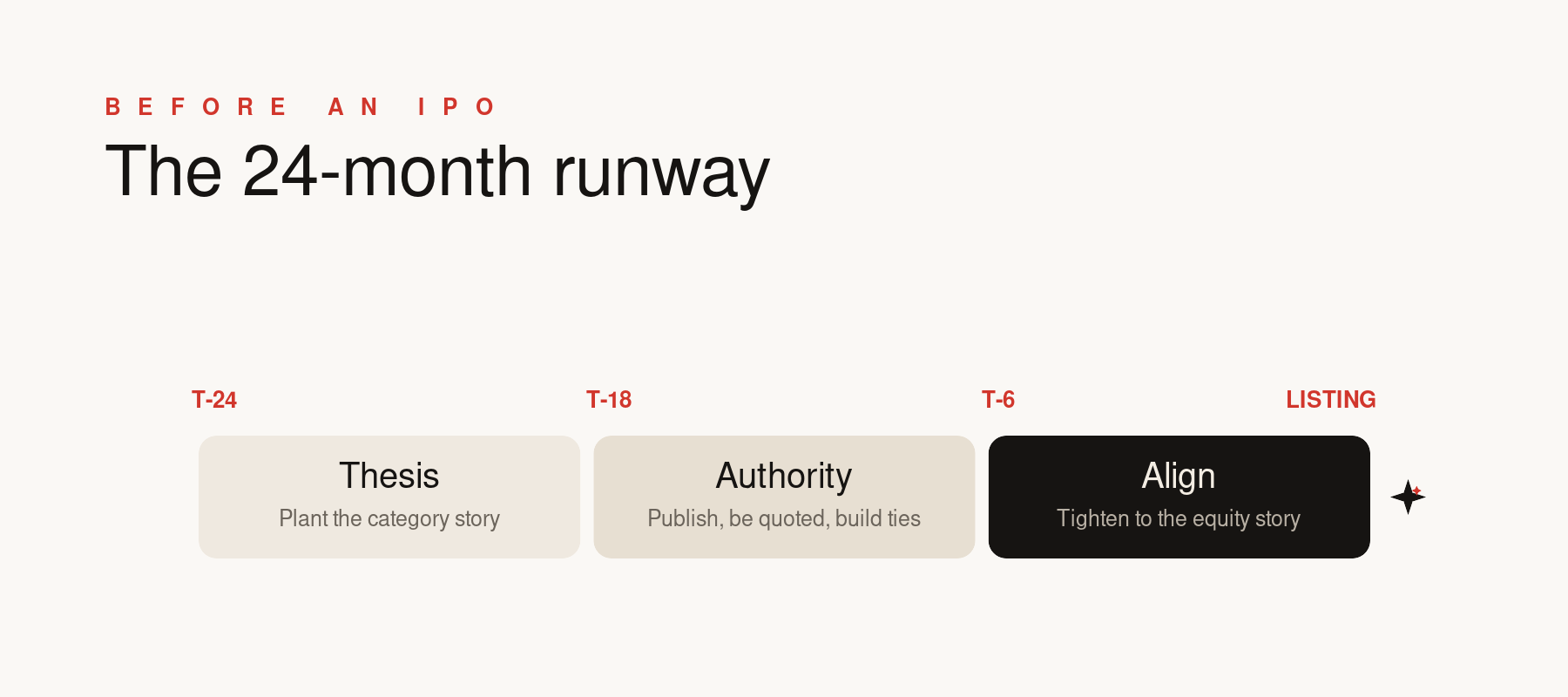
The runway breaks into three phases.
In the first phase, roughly two years to eighteen months out, you establish the thesis. What is the category story only you can tell? What is the trend you are riding and can explain better than anyone? This is where you plant the narrative the equity story will later stand on.
When Nykaa listed, Falguni Nayar had spent years as a credible, visible operator with a clear story about Indian beauty retail. The presence was not invented for the IPO. It was already there.
In the middle phase, eighteen to six months out, you build authority and relationships. Consistent publishing, selective media, a handful of considered op-eds in the outlets your investors actually read. You become a name analysts recognise before you are a name they are pricing.
In the final phase, six months to listing, you tighten and align. Everything you say now has to reconcile with the equity story and respect the constraints of a quiet period. This is where a wrong word is expensive, and where discipline matters more than reach.
The investor-relations dimension
Most founder-branding advice ignores the audience that decides an IPO. Public-market investors do not read your feed for entertainment. They are pattern-matching for judgement, candour, and command of the business. A founder who has demonstrated all three in public for two years lowers the perceived risk of the offering, and that shows up in conversations, in coverage, and in the quality of the book.
This is the part generic personal-branding help cannot touch, because it requires understanding both the narrative and how investors actually read one. It is the intersection we work at.
Start before you think you need to
The best time to have begun was two years ago. The second best is now. If a listing is anywhere on your three-year horizon, the runway has already started, whether you are using it or not.
If you want to build the habit first, the ninety-day system is the place to start. And if you want operators with both marketing and public-markets experience to build the presence with you, get in touch.