
CXO to CEO: Building the Persona That Gets You the Top Job
Every shortlist for a top job contains people who can do the job. That is the price of entry, not the differentiator. When a board or a promotions committee chooses a CEO, they are not comparing spreadsheets of who hit their numbers. They are deciding who they can put in front of investors, employees, and the press and feel proud. That decision runs on presence, and presence is built, not discovered on the day.
If you are a CXO with your eye on the corner office, your execution is already assumed. The gap between you and the other finalists is not competence. It is whether the market has a picture of you as a leader, or only as a function.
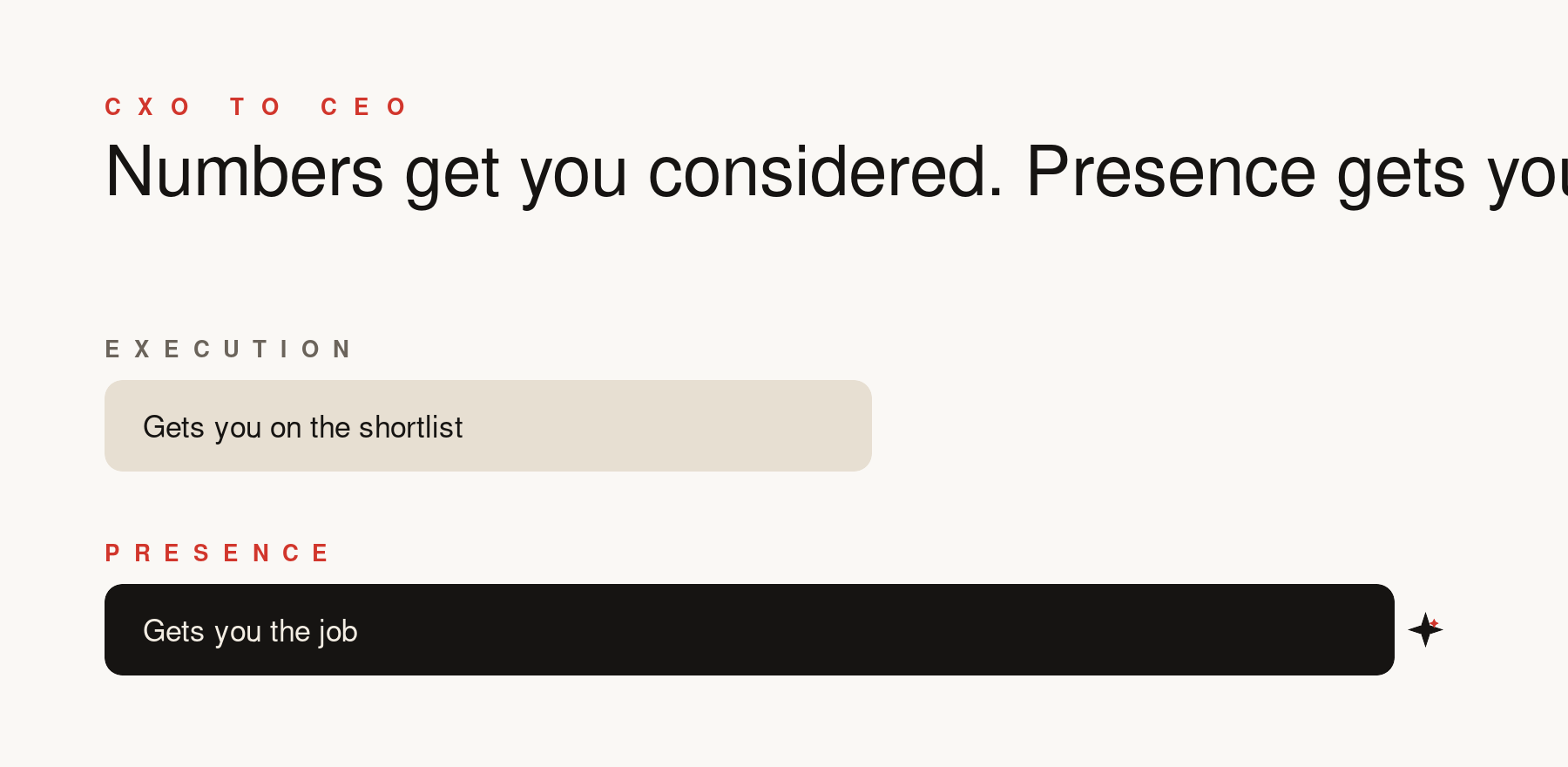
Numbers get you considered. Presence gets you chosen.
There is a ceiling to what quarterly performance can do for a career, and most senior executives hit it without noticing. Delivering results makes you valuable inside the building. It does very little outside it, where the perception that decides big roles actually lives.
Satya Nadella did not become the obvious internal choice at Microsoft only because of the cloud numbers. He had a distinctive, humane point of view about where technology was going, and people inside and outside the company knew it. The numbers made him credible. The point of view made him the leader they wanted.
Build the leader, not the résumé
A CXO brand is not a list of achievements. It is a consistent, recognisable way of seeing your industry that other people can repeat when you are not in the room. That is the test. Can a board member, in one sentence, say what you stand for? If the honest answer is your function, you have work to do.
Start with a category position. Pick the shift happening in your industry that you understand better than your peers, and take a clear line on it in public. Not safe commentary, a position. The willingness to be specific is what separates a leader with a view from a senior person with opinions.
Then let the personal show through. The market does not promote functions to CEO. It promotes humans it trusts with ambiguity. The judgement calls, the way you handle a hard decision, the operator's lessons that do not fit on a CV, these are what make a persona legible and worth betting on.
The quiet, professional version
None of this means becoming a personality. For most CXOs the right register is exactly the one you would use with your board: measured, candid, occasionally contrarian, never loud. You are not auditioning for influencer status. You are building the evidence a serious person needs to be handed a serious job.
Do it consistently for a year and something shifts. Recruiters call with the roles you actually want. Your name enters conversations you are not in. The internal committee has an easier decision, because the external market has already validated you.
The move is deliberate
The CXOs who make the jump rarely leave it to chance. They build the presence on purpose, early, and let it do the arguing.
If you want to start with a repeatable cadence, the ninety-day system is built for exactly this.
And if you want a partner who understands both the boardroom and the market to build it with you, get in touch.